
Choosing among wheelchair ramp suppliers in India starts with understanding the entrance, the user and the site. A ramp that suits a home doorstep may fail at a hospital lobby. Accessible entrances, safe circulation and inclusive public spaces remain a daily concern across Indian cities.
This guide explains common ramp types, supplier evaluation, safety considerations and related mobility solutions such as vehicle modifications. Ramps remove steps, but they work best as part of a wider plan. Whether you manage a hospital, bank, school or housing society, the points below apply.
Why wheelchair accessibility matters in Indian buildings
Wheelchair accessibility means a person can reach, enter and use a building independently and safely. Many Indian buildings still rely on steps at the main entrance, narrow doorways or uneven approaches.
Hospitals and clinics see patients with limited mobility daily. Banks, offices and schools serve visitors who may not be able to use stairs. In housing societies, steps at lobbies, clubhouses and garden paths limit seniors, caregivers and residents who use wheelchairs.
Accessible design supports independence, reduces fall risks and improves the visitor experience. It also enables inclusive participation in work, education, banking and healthcare. Even a short step can stop a wheelchair user at the door. Removing that barrier benefits parents with prams, delivery staff and older visitors too.
Types of wheelchair ramps and their applications
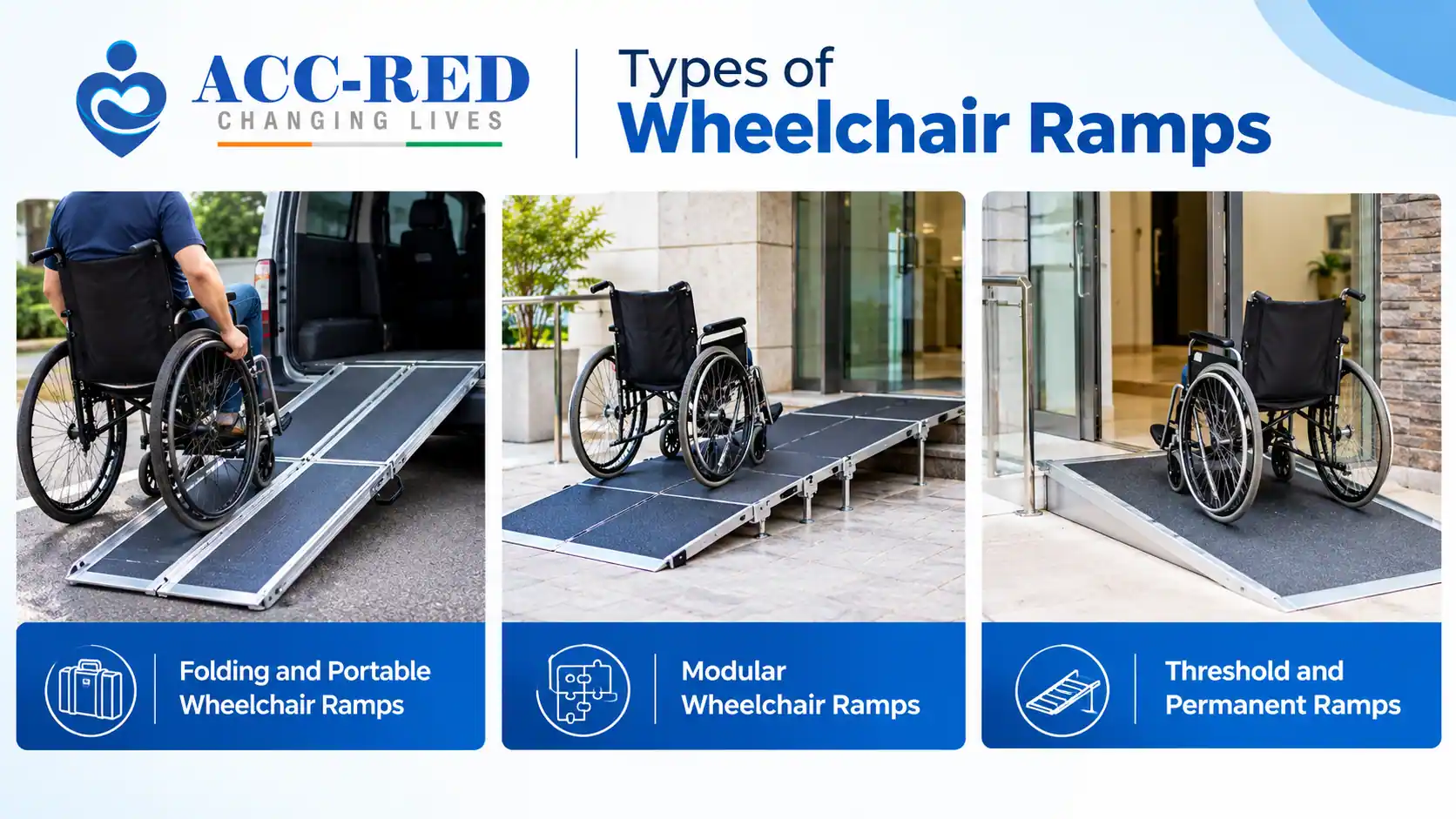
Wheelchair ramps differ mainly in portability, configurability and permanence. The right type depends on rise, frequency of use and site conditions. In short, folding ramps offer flexibility, modular ramps offer configurability, and threshold or permanent ramps offer long-term convenience at fixed points.
Folding and portable wheelchair ramps
Folding ramps fold or telescope for easy carrying and storage. They suit temporary access, travel, shop entrances and homes where steps cannot be altered. Always confirm rise, length and load rating before use. See Acc-Red's portable wheelchair ramps.
Modular wheelchair ramps
Modular ramps are built from sections, so they adapt to different layouts and heights. They suit entrances with larger level differences or limited space. Landings and turns can be configured after measuring the site. Explore modular ramp systems for semi-permanent installations.
Threshold and permanent ramps
Threshold ramps bridge small level changes at doorways. Permanent ramps are fixed solutions for entrances that need ongoing access. Both require appropriate dimensions, secure placement and a surface suited to the conditions.
How to choose wheelchair ramp manufacturers and suppliers in India
A good supplier recommends a product only after understanding the user, the wheelchair and the entrance. Compare these factors:
- Product suitability and documented load ratings.
- Ramp length, width, gradient and available approach space.
- Surface grip, edge protection and safe transitions.
- Material quality and suitability for rain, heat or heavy use.
- Site assessment and installation capability.
- Documentation, maintenance and after-sales support.
Ask for written specifications, a clear installation scope and a named contact for support. Be cautious of claims that sound universal, such as one ramp fitting every site.
Roles also differ. A wheelchair ramp manufacturer makes products. Wheelchair ramp suppliers sell them, often from several makers. Installation partners measure, fit and hand over the solution. Many buyers need all three, so ask every provider which role it performs.
Wheelchair ramp safety and accessibility requirements in India
The Rights of Persons with Disabilities Act, 2016 promotes barrier-free access to buildings and public facilities. The Ministry of Housing and Urban Affairs' Harmonised Guidelines and Space Standards for Barrier Free Built Environment provide technical detail.
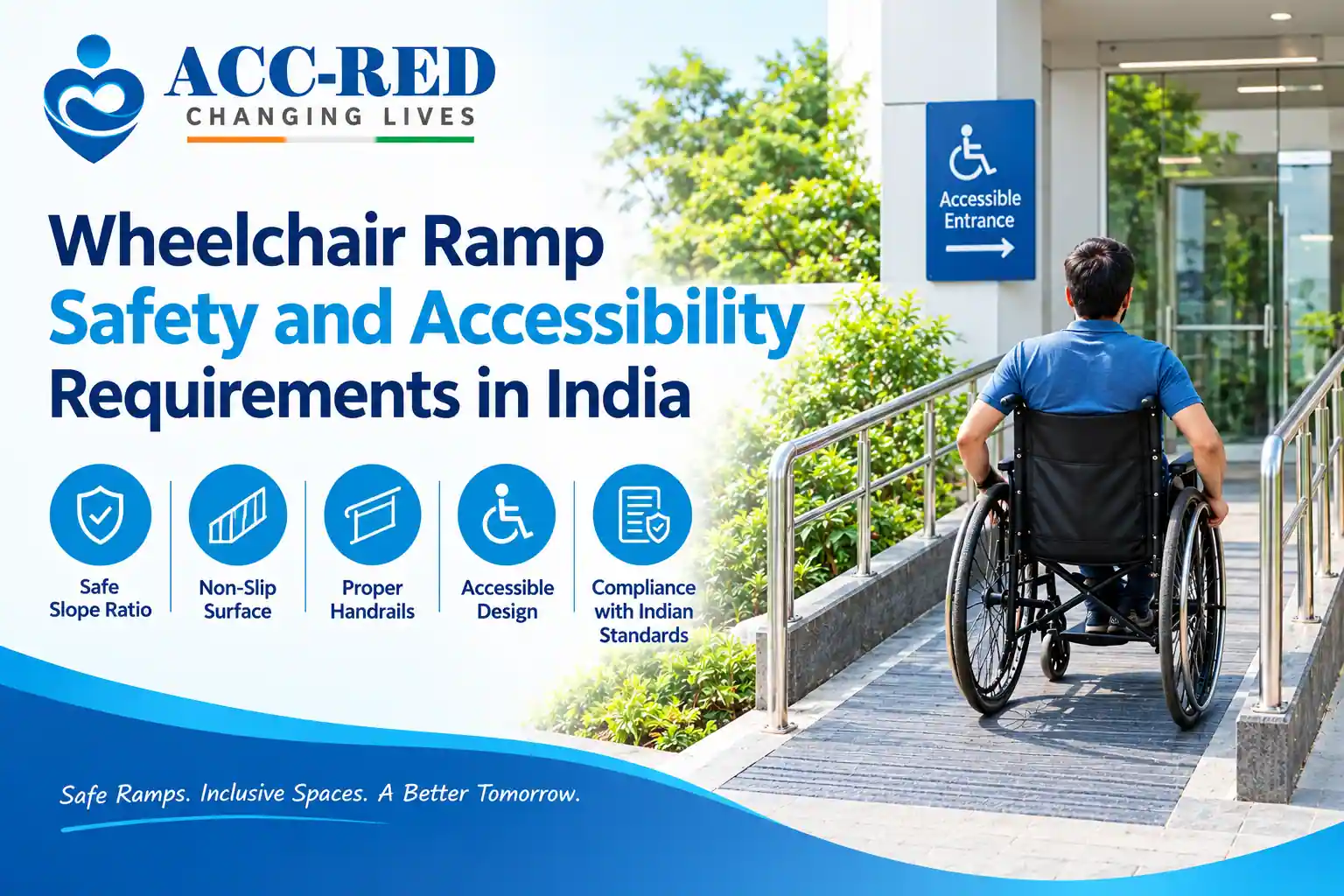
Safe ramps need a suitable slope, clear route width, level landings, handrails where required and a non-slip surface. Transitions should not create trip points. Handrails help users and companions, especially on longer ramps. Monsoon rain can make smooth surfaces slippery, so grip and drainage deserve attention.
Wheelchair-accessible cars and mobility solutions
A wheelchair-accessible vehicle lets a user enter, travel and exit safely. Depending on the vehicle, solutions may include vehicle ramps, wheelchair lifts, floor levelling, roof extensions, suitable entry arrangements and securement systems.
The right choice depends on the vehicle, the wheelchair, passenger needs and safe entry and exit. If you are exploring a wheelchair-accessible car in India, Acc-Red can assess your existing vehicle or guide you before purchase. Test the arrangement with the actual user, and confirm any modification suits applicable vehicle regulations. Ask the provider to demonstrate boarding and wheelchair securement before you commit.
What to expect from a physical accessibility solutions company
A physical accessibility solutions company moves you from "we have steps" to a usable, documented solution. A capable partner should:
- Identify physical barriers at entrances, routes and facilities.
- Conduct a site assessment with accurate measurements.
- Recommend suitable products for the user and site.
- Coordinate supply and installation.
- Check the completed solution for usability.
- Support wider, multi-site accessibility projects.
Ask for measurements, product specifications and handover documents so facility teams can maintain the solution later. Acc-Red's accessibility services assess requirements, supply and install products, and document completion for banks, corporates, hospitality, healthcare and public spaces.
From accessibility assessment to implementation
A practical project follows six steps: assess the site, identify barriers, select a suitable solution, plan installation, check usability and document the outcome. In a hospital, this might cover the main entrance, outpatient route and pharmacy counter. In a housing society, it may include lobby steps, clubhouse access and garden paths.
Acc-Red's portable ramps helped make 50+ residential buildings in Reliance Township, Nagothane wheelchair accessible.
Frequently asked questions about wheelchair accessibility
How do I choose the right wheelchair ramp supplier in India?
Check product suitability, technical specifications, load ratings, installation expertise and after-sales support. Prefer suppliers who assess the site first, and compare at least two written proposals where possible.
When should I choose a folding wheelchair ramp?
Choose one for temporary access, travel or small steps where permanent changes are not possible. Dimensions, load rating, slope and site conditions must still be assessed.
What should I check before installing a wheelchair ramp?
Measure the rise and available space. Then check ramp length, width, landings, surface grip, transitions and applicable accessibility requirements.
Can accessibility solutions include wheelchair-accessible vehicles?
Yes. Accessibility planning can cover both building access and suitable vehicle modifications, so users can travel safely from home to destination.
Plan your accessibility requirements with Acc-Red
Choosing appropriate accessibility solutions for buildings and transportation improves safety and independence. The best outcome starts with a proper assessment, not the first product you see.
Whether you are comparing wheelchair ramp suppliers in India or planning a vehicle modification, discuss your requirements with Acc-Red. Share your site, user needs and timeline, and the team can advise on suitable next steps.
Accessibility Redefined Pvt. Ltd. (Acc-Red) assesses, supplies, installs and documents accessibility solutions for banks, corporates, hospitality, healthcare and public spaces across India. Explore ramps, lifts and vehicle accessories.
Planning an accessible entrance or mobility solution?
Discuss your requirements